

Buy Organic Loose Leaf Tea Online: 2026 Buyer's Guide
Table of Contents
- Why Buy Organic Loose Leaf Tea Online in 2026
- Shop by Tea Type: Green, Black, White, Oolong, and Pu-erh
- The Benefits of Organic Loose Leaf Tea, Backed by What's in the Cup
- How to Brew Loose Leaf Tea Without Wrecking the Flavor
- The Best Way to Store Loose Leaf Tea So It Stays Fresh
- How to Vet an Online Tea Seller Before You Check Out
- Conclusion: Start Your Morning Ritual with Tea You Can Trust
- Frequently Asked Questions
Last Updated: September 11, 2026
Why Buy Organic Loose Leaf Tea Online in 2026
Buying organic loose leaf tea online is the most reliable way to get fresh, traceable leaves without a middleman's markup. At Bright N Early, we source and ship whole-leaf teas with the same care we put into our fresh-roasted coffee. This guide covers certifications, brewing, storage, and how to spot a trustworthy seller. This guide covers certifications, brewing, storage, and how to spot a trustworthy seller.
As drinkers move away from mass-produced bags, online sellers now offer harvest dates, garden names, and lot numbers that grocery shelves rarely show. That transparency is the whole point.
Shop by Tea Type: Green, Black, White, Oolong, and Pu-erh
Every tea type comes from the same plant, Camellia sinensis, but oxidation and processing decide how it tastes. Green teas are minimally oxidized, blacks fully, and oolongs sit in between. White teas use young buds with almost no processing, while pu-erh undergoes fermentation and improves with age.
When you shop, match the type to your ritual:
- Green for light, grassy cups and a gentler caffeine lift
- Black for bold, malty flavor that stands up to milk
- White for delicate, floral notes and lower caffeine
- Oolong for a range between green and black, often roasted
- Pu-erh for earthy, deep cups that reward patience
Single-origin lots let you taste the difference between a tea garden in one region and another. Blends, by contrast, are built for consistency.
Herbal Tisanes and Caffeine-Free Infusions
Herbal tisanes are not true teas; they are infusions of botanicals like chamomile, peppermint, rooibos, or hibiscus. With no leaves from the tea plant, they are naturally caffeine-free and safe for an evening cup. Look for organic certification here too, since herbs are often sprayed more heavily than tea leaves.
The Benefits of Organic Loose Leaf Tea, Backed by What's in the Cup
Organic loose leaf tea offers more than a cleaner label: whole leaves release their compounds slowly, so you taste more of what the plant contains. Tea leaves naturally hold antioxidants called polyphenols, including the tannins that give a cup its structure.
Whole leaf unfurls gradually, so you can steep the same leaves two or three times and get a different flavor each round. Bagged dust gives you one flat cup and nothing more.
How to Brew Loose Leaf Tea Without Wrecking the Flavor
Brewing loose leaf tea well comes down to three controls: water temperature, leaf-to-water ratio, and time. Get those right and even an inexpensive tea tastes clean. Get them wrong and the best leaves turn bitter.
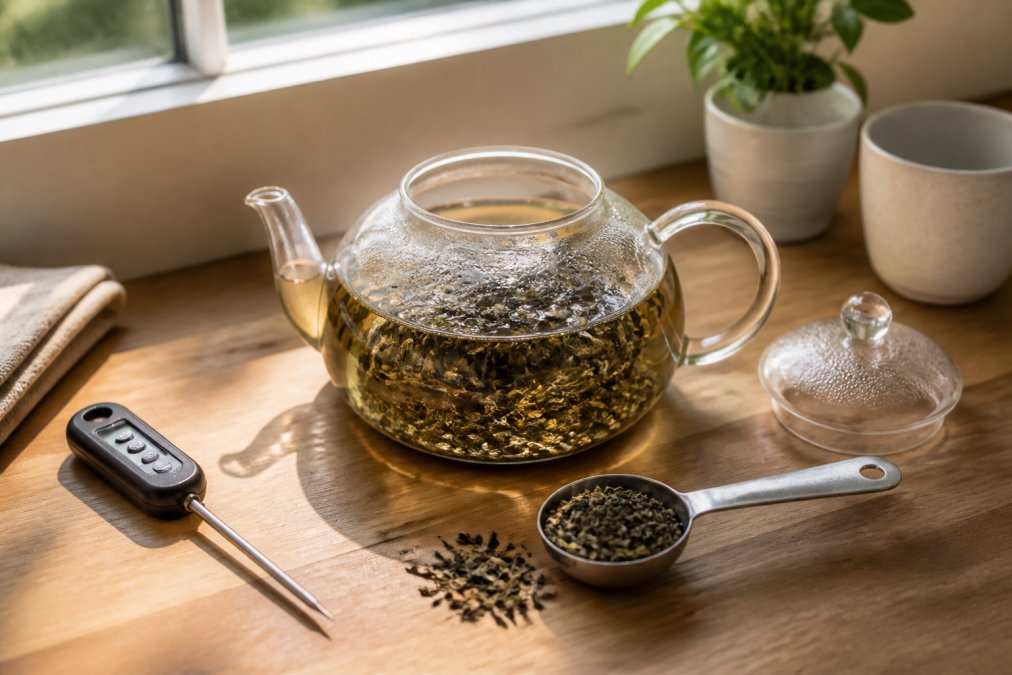
Most brewing problems trace back to four mistakes: water too hot for the leaf, too much leaf for the water, steeping past the point where tannins turn harsh, or re-steeping spent leaves. Each has a fix, and none require more than a thermometer and, ideally, a small kitchen scale.
Water Temperature and Steeping Ratios by Tea Type
Start with roughly one teaspoon of leaf per 8 ounces of water, then adjust to taste. The table below is a solid baseline.
| Tea Type | Water Temperature | Leaf per 8 oz | Steep Time | Re-steeps |
|---|---|---|---|---|
| Green | 160-175°F | 1 tsp | 2-3 min | 2-3 |
| White | 175-185°F | 1 heaping tsp | 3-4 min | 2-3 |
| Oolong | 185-200°F | 1 tsp | 3-4 min | 3-4 |
| Black | 200-212°F | 1 tsp | 3-5 min | 2-3 |
| Pu-erh | 200-212°F | 1 tsp, rinsed first | 3-5 min | 4+ |
A few notes that the table cannot capture:
- Green and white teas are the most sensitive to heat. Pouring a full rolling boil over them scalds the leaf and pulls out harsh tannins. Let the kettle rest two to three minutes after it clicks off, or pour the water into a cool pitcher first and then over the leaf.
- Oolong rewards a short rinse. A five-second pass with hot water wakes the leaf and discards dust before the first real steep.
- Pu-erh is compressed, so it needs both a rinse and a longer first steep. Many drinkers give it a 10-second rinse, pour that off, then start the clock.
- Re-steeping works because whole leaf unfurls gradually. Each subsequent steep should run slightly longer than the last, add 30 to 60 seconds per round, because the leaf gives up its compounds more slowly as it opens.
Why Ratios Matter More Than Temperature Alone
New loose leaf drinkers often under-leaf and over-steep, producing a weak, bitter cup: the water extracts tannins before the sugars and aromatics that balance them. The fix is counterintuitive, use more leaf and less time. A generous teaspoon in 8 ounces for two minutes beats a scant teaspoon for five.
If you drink by the mug, scale the ratio, not the time. A 16-ounce mug wants roughly two teaspoons of leaf and the same steep time as an 8-ounce cup. Doubling the time instead of the leaf is the most common way a good tea goes bitter.
Water Quality and Vessel Choice
Tea is mostly water, so the water matters. If your tap water tastes strongly of chlorine or minerals, the tea will too; a simple carbon filter pitcher is enough for most households. Distilled water lacks the minerals that help extract flavor.
Glass and glazed ceramic are neutral and let you watch the leaf unfurl. Unglazed clay, especially porous pots for oolong and pu-erh, absorbs flavor over time and is best dedicated to one tea type. Metal infusers are fine for a quick cup but can leave a metallic edge on delicate whites and greens.
A Simple First-Cup Routine
If you are new to loose leaf, start here: heat water to 175°F, measure one heaping teaspoon into a glass teapot or a mug with an infuser, pour 8 ounces over the leaf, and set a timer for two and a half minutes. If it is too weak, add 30 seconds next time; if bitter, drop the temperature by 10 degrees or shorten the steep. Repeat with the same tea for a week before changing variables.
The Best Way to Store Loose Leaf Tea So It Stays Fresh
The best way to store loose leaf tea is in an airtight, opaque container kept away from light, heat, moisture, and strong smells. Tea leaves are porous, so they absorb whatever is nearby. A tin next to your spice rack will taste like your spice rack within weeks.
The four enemies of tea are light, heat, oxygen, and moisture. Light breaks down the chlorophyll and aromatics that give green and white teas their brightness. Heat accelerates oxidation, turning a fresh green grassy and a fresh black flat. Oxygen slowly oxidizes the leaf after processing. Moisture is worst, because damp leaf does not just go stale, it can grow mold.
What to Store Tea In
- Airtight tins with a double lid or a silicone gasket are the standard. A simple push-top tin is not airtight enough for more than a few weeks.
- Opaque or dark glass matters as much as the seal. A clear jar on a sunny counter will fade a green tea in a month.
- Mylar or foil-lined pouches with a heat seal are what many sellers ship in, and they are genuinely good for storage if you reseal them. Roll the top down, clip it, and keep the pouch inside a tin for extra protection.
- Avoid cardboard boxes, paper bags, and the thin plastic bags some tea arrives in. None of them block oxygen or odor.
How Long Each Tea Type Actually Keeps
Freshness windows vary by type, and knowing them keeps you from over-buying:
- Green and white teas are the most perishable. Plan to finish them within six to twelve months of the harvest date. After that they do not spoil, but the bright, vegetal notes fade.
- Oolong sits in the middle. Lighter, greener oolongs behave like green tea; darker, roasted oolongs hold up for a year or more and often improve slightly in the first few months as the roast settles.
- Black tea is the most forgiving. Sealed and kept cool, it holds its character for eighteen months to two years.
- Pu-erh is the exception to every rule. It is a fermented, aged tea that is meant to keep developing. Store it in a breathable wrapper in a cool, dark place with some airflow, away from other teas, and it will change over years rather than fade.
The Refrigerator and Freezer Question
Refrigeration is the most misunderstood storage advice in tea (PubMed). Cold slows oxidation, but the moment a cold container is opened in a warm kitchen, condensation forms on the leaf, moisture that does more damage than the cold prevents.
If you do refrigerate or freeze tea, follow two rules: the container must be truly airtight, and the tea must come to room temperature before opening. For most households, a cool dark cupboard is simpler and safer. Reserve cold storage for bulk purchases you will not touch for months, portioned into smaller sealed bags.
A Storage Routine That Works
- Transfer tea out of any flimsy bag into an airtight tin
- Keep containers in a cool, dark cupboard, not above the stove
- Store each tea type separately to prevent flavor crossover
- Buy in quantities you will finish within the freshness window for that type
- Label with the purchase date and the harvest date so you know what is fresh
- Keep a small "drink now" tin on the counter and the rest sealed away
Why This Matters When You Buy Online
When you buy organic loose leaf tea online, you cannot smell the leaf before you commit, so storage is your only lever after the box arrives. A seller who prints a harvest date gives you the information you need to plan; one who does not is asking you to guess. Treat the harvest date as the starting line for every freshness window above.
How to Vet an Online Tea Seller Before You Check Out
Before you buy organic loose leaf tea online, check four things: certification, sourcing transparency, freshness signals, and shipping speed. A seller who publishes harvest dates and garden names usually cares about what they ship.
You can verify organic claims through the USDA National Organic Program, which maintains the standards behind the organic seal. For fair trade claims, Fair Trade USA lists certified products and producers.
Certifications, Sourcing Claims, and Sustainability Practices
Look for a stated certification body, not just the word "natural." Terms like "pesticide-free" or "non-GMO" carry less legal weight than certified organic. Direct trade and regenerative agriculture claims are worth asking about, but should come with specifics about the farm.
Bulk Loose Leaf Options and Subscription Convenience
Bulk buying lowers the cost per cup, but only if you will drink it before it fades. Subscriptions solve the freshness problem by shipping smaller amounts on a schedule. Choose bulk for a daily favorite and a subscription for variety.
Conclusion: Start Your Morning Ritual with Tea You Can Trust
Choosing tea you can trust means reading labels, brewing with care, and storing leaves so they stay fresh. Those small habits separate a forgettable cup from one worth waking up for.
Bright N Early ships real loose-leaf tea and fresh-roasted coffee. Our selection is built on carefully sourced leaves and no shortcuts. Get started with Bright N Early and make your morning ritual one you actually look forward to.
Frequently Asked Questions
What are the cleanest brands of loose leaf tea?
The cleanest brands carry third-party organic certification, such as the USDA Organic seal, and publish where their tea is grown. Look for pesticide-free and non-GMO claims that are backed by a certifier, not just marketing copy. Brands that name the tea garden or region and describe their harvest season tend to be more transparent. When you buy organic loose leaf tea online, check the product page for certification details and sourcing notes before you order.
How do I know if my loose leaf tea is truly organic?
Check the packaging for the USDA Organic seal and a certifier name. Organic certification requires annual inspections and documented growing practices, so a legitimate seller will display it clearly. If a listing only says 'natural' or 'pure' without a seal, treat it as conventional tea. You can also contact the seller and ask for the certifier's name, which a serious organic loose leaf tea supplier will provide without hesitation.
What is the best way to store loose leaf tea at home?
Keep tea in an airtight container away from light, heat, and moisture. A sealed tin or opaque glass jar stored in a dark cabinet works well. Avoid the refrigerator, since condensation and food odors seep in. Buy in quantities you will finish within a few months, because flavor fades with exposure to air. If you purchase bulk tea, split it into smaller containers so you open the main supply less often.
How much loose leaf tea should I use per cup?
A general starting point is one teaspoon of loose leaf tea per 8 ounces of water, then adjust to taste. Whole leaf teas often need a little more volume because the leaves are larger, while fine-cut teas may need less. Water temperature matters too: green and white teas do best around 160-180°F, while black and pu-erh teas handle 200-212°F. Steep 2-4 minutes for most types and taste before adding anything.