

How to Keep Roasted Coffee Fresh: 2026 Storage Guide
Table of Contents
- How Long Does Roasted Coffee Stay Fresh?
- Why Oxygen, Light, and Heat Destroy Bean Integrity
- Coffee Storage Containers: Material Science and One-Way Valve Bags
- Freezing Coffee Beans: When It Works and When It Backfires
- How to Store Coffee for Different Climates and Travel
- Buying Smaller Batches and Timing Your Brew Cycle
- Common Mistakes That Ruin Freshly Roasted Coffee
- Conclusion
- Frequently Asked Questions
Last Updated: September 14, 2026
How Long Does Roasted Coffee Stay Fresh?
Roasted coffee stays fresh for roughly two to four weeks after the roast date when stored in an airtight, opaque container away from heat and moisture (Changes in sensory quality characteristics of coffee during storage). Whole beans hold their peak flavor longer than pre-ground coffee because less surface area is exposed to oxygen from the start.
That window is shorter than most people assume. A bag sitting open on the counter loses its best qualities within days, not months.
Bright N Early roasts every order to ship, so the clock starts when the bag is sealed, not when it hits a grocery shelf. Below, we'll show you exactly how to keep roasted coffee fresh from the first scoop to the last, and why the usual pantry advice only gets you halfway there.
The Freshness Timeline: From Roast Date to Peak Flavor
Roasted coffee moves through three broad phases. In the first few days, beans release carbon dioxide in a process called degassing. Flavor is still developing. From about day four to day fourteen, most beans hit peak flavor, when aroma and volatile compounds are at their fullest. After that, oxidation gradually flattens the cup.
Signs Your Coffee Has Gone Stale
Stale coffee announces itself before you taste it. The aroma fades first, then the flavor turns flat or papery, and the brew loses the brightness that defines a good roast. If your beans smell like cardboard or sawdust, they are past their best.
Why Oxygen, Light, and Heat Destroy Bean Integrity
Oxygen, light, and heat are the three main enemies of coffee fresh flavor, and they work together. Oxygen drives oxidation, which breaks down the coffee oils that carry aroma. Light and heat accelerate that breakdown, so a warm, sunny spot does double damage.
The Science of Off-Gassing and Carbon Dioxide
Freshly roasted beans release carbon dioxide for days after roasting. That off-gassing is why a sealed bag puffs up, and why a one-way valve matters: it lets carbon dioxide escape without letting oxygen in. Trap the gas and the bag can burst; block the valve and oxygen creeps back.
How UV Light and Temperature Fluctuation Speed Up Staling
UV light breaks down volatile compounds even through thin packaging (pubmed.ncbi.nlm.nih.gov). Temperature fluctuation is subtler but just as damaging, because every warm-cool cycle pushes moisture and air in and out of the bean. A cool and dark cabinet beats a countertop jar every time.
Coffee Storage Containers: Material Science and One-Way Valve Bags
The best coffee storage containers block oxygen, light, and moisture at once, and material choice decides how well they do it. Most guides stop at "use something airtight." That advice is incomplete, because two containers can both be airtight and still perform very differently depending on how their walls handle light, oxygen, and internal gas pressure.
What Each Material Actually Does
Stainless steel. Opaque to the full light spectrum, including UV, and effectively impermeable to oxygen at the wall. The trade-off is that steel is rigid, so it cannot vent on its own. A steel canister with a one-way valve lid solves that; a plain screw-top steel tin does not, and pressure from fresh degassing beans will push the lid or force gas past the threads.
Opaque ceramic. Blocks light well and holds temperature steadily, which slows the warm-cool cycling that drives staling. The weakness is the seal. Ceramic lids are usually gasket-based and degrade with washing, so a ceramic canister is a good short-term counter vessel and a poor long-term one.
Clear glass. The worst of both worlds for storage. Glass is heavy and seals reasonably well with a gasket, but it transmits visible light and UV, which break down the volatile aroma compounds in coffee oils. A clear jar on an open shelf is a display piece, not a storage solution. If you like seeing your beans, keep the jar inside a closed cabinet.
Plastic. Lightweight and cheap, but most food-grade plastics are slightly oxygen-permeable over time, and many retain odors from previous contents. Plastic is fine for a week; it is not a long-term vessel.
Vacuum-sealed bags and canisters. Removing air removes the oxygen that drives oxidation, which is why vacuum sealing is the strongest option for beans you will not touch for weeks (pubmed.ncbi.nlm.nih.gov). The catch is that vacuum sealing fresh beans too early traps carbon dioxide and can crush the bean structure. Vacuum seal after the degassing window, not on roast day.
Why One-Way Valve Bags Outperform Rigid Containers
One-way valve bags solve a problem rigid containers cannot. Freshly roasted beans release carbon dioxide for days, and that gas has to go somewhere. A rigid sealed canister traps it, building pressure that either forces the seal or, in a fully sealed bag, risks rupture. A one-way valve lets carbon dioxide escape while blocking oxygen from entering, which is why roasters ship in them.
If you transfer beans to a canister, keep the valve bag for short-term storage and use the canister only for what you'll brew within a week. The valve bag is engineered for coffee; most canisters are engineered for shelf appeal.
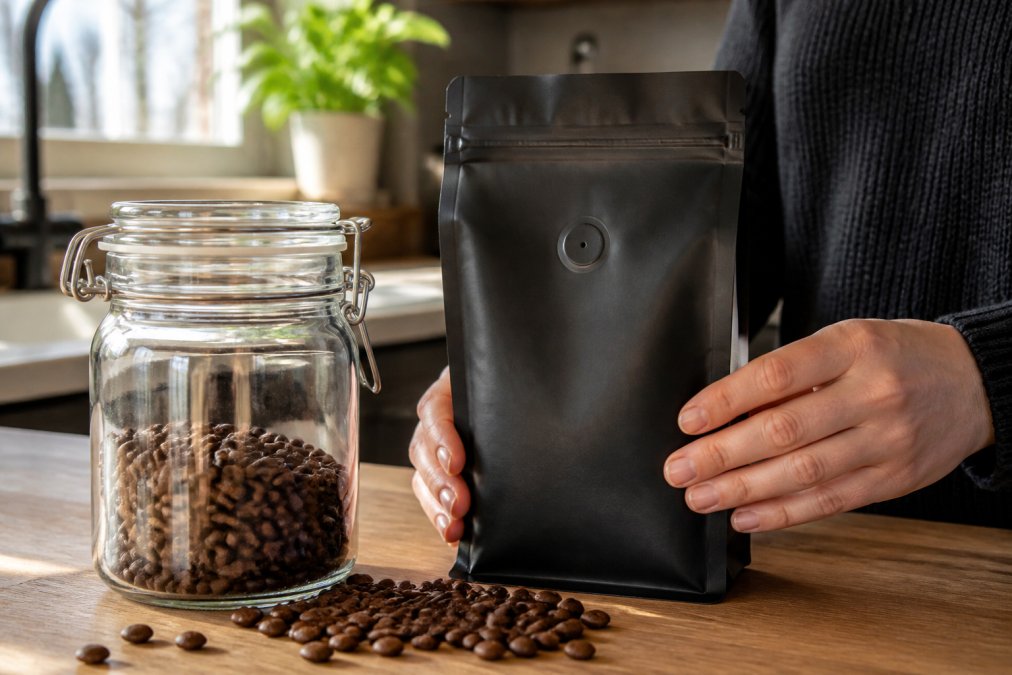
A quick comparison of common storage vessels:
| Container | Light Protection | Airtight Seal | Handles Off-Gassing | Best For |
|---|---|---|---|---|
| One-way valve bag | High | High | Yes | Daily use, degassing beans |
| Stainless steel with valve lid | High | High | Yes | Long-term counter storage |
| Opaque ceramic canister | High | Medium | No | Short-term counter storage |
| Clear glass jar | Low | Medium | No | Display only, not storage |
| Vacuum seal bag | High | High | No (seal after degassing) | Long-term freezing |
Freezing Coffee Beans: When It Works and When It Backfires
Freezing coffee beans works when you freeze whole beans in an airtight, vacuum-sealed bag and thaw them fully before grinding. It backfires when you freeze and refreeze, or when you open the bag while it is still cold, because condensation introduces moisture that ruins bean integrity.
The key is portioning. Freeze in one-week batches so you never thaw more than you'll use. Grind size matters here too: freeze whole beans, not ground coffee, since ground coffee exposes far more surface area to oxygen and moisture.
How to Store Coffee for Different Climates and Travel
Humidity is the variable most storage guides ignore. The standard "cool, dark, dry" advice assumes a mild indoor environment, and it falls apart in a humid coastal kitchen, a dry high-desert home, or a campsite where none of those conditions exist.
Climate-Specific Storage
High humidity. Moisture is the primary threat. Every time you open a container, humid air enters and condenses as the temperature drops. Airtight seals matter more than temperature control here, and a desiccant pack inside the storage vessel absorbs the moisture that slips in during scooping. Keep the container closed between scoops and never store beans near a kettle, dishwasher, or sink.
Arid climates. Low humidity means moisture is less of a concern, but wide day-night temperature swings are. Each warm-cool cycle pushes air in and out of the bean and drives off volatile compounds. A stable, insulated spot, such as an interior cabinet away from exterior walls, beats a spot that is merely cool on average.
Tropical and coastal. Combine both problems: high humidity plus heat. This is the one case where the freezer earns its keep for everyday storage, provided beans go in whole, in vacuum-sealed portions, and thaw fully sealed before opening.
Travel and Long-Term Transit Storage
For travel, skip the glass jar entirely. Glass is heavy, breaks, and offers no light protection. A vacuum seal bag or a one-way valve bag packed in a hard-sided case protects beans from pressure changes, jostling, and the temperature swings of a car trunk or overhead bin.
A practical travel protocol:
- Portion beans into single-use vacuum bags before you leave, sized to what you'll brew per day.
- Pack a hand grinder rather than pre-grinding. Ground coffee stales in hours, not weeks.
- Keep the day's portion in a small valve bag in your carry-on; keep the rest sealed in the checked bag or cooler.
- If you're camping or on the road for weeks, buy in smaller batches along the way and accept that peak flavor has a short shelf life.
Buying Smaller Batches and Timing Your Brew Cycle
Buying in smaller, frequent batches is the single most effective storage strategy. You cannot out-store time. A bag you finish in two weeks will always taste better than the same coffee stretched over two months.
Match your batch size to your brew cycle. If you brew one cup a day, a smaller bag lasts about two weeks. If you brew for a household, size up, but only to what you'll finish within a month.
Common Mistakes That Ruin Freshly Roasted Coffee
Most storage mistakes come from good intentions. Here are the ones that do the most damage:
- Storing beans in the fridge instead of the freezer
- Using a clear glass jar on an open shelf
- Grinding the whole bag at once instead of per brew
- Refreezing beans after they've thawed
- Leaving the bag open between scoops
- Buying more coffee than you can finish in a month
A common mistake is grinding a full week's worth at once for convenience. Ground coffee stales far faster than whole beans, so grind just before you brew whenever you can.
Conclusion
Keeping roasted coffee at its best comes down to controlling oxygen, light, heat, and moisture, and buying only what you'll drink while it's still fresh. At Bright N Early, every order is roasted to order and shipped in one-way valve bags, so your beans arrive at the start of their freshness window, not the end.
Our carefully sourced beans, real loose-leaf teas, and no-shortcuts approach are built for people who care about the ritual, not just the caffeine. If you want maximum flavor and aroma in every cup, start with coffee that was fresh when it left the roaster.
Get started with Bright N Early and taste what roasted-to-order coffee actually delivers.
Frequently Asked Questions
Is coffee roasted 4 months ago still good?
Coffee roasted four months ago is past its peak. Most roasted coffee tastes best within 2 to 4 weeks of the roast date. After that, oxidation and moisture exposure flatten the aroma and flavor profile. You can still brew it, but expect a duller cup with less complexity. For the best sensory experience, buy from a roaster that ships within days of roasting.
How long can roasted coffee stay fresh?
Whole bean coffee stays fresh for about 2 to 4 weeks in an airtight container stored in a cool, dark place. Ground coffee loses its peak flavor within 3 to 7 days because more surface area is exposed to oxygen. Freezing whole beans can extend freshness to 1 to 2 months if you seal them properly and avoid repeated thawing.
Will coffee stay fresh in a Ziploc bag?
A Ziploc bag slows staling but does not stop it. Standard plastic bags are not airtight enough to block oxygen exposure, and they offer no UV light protection. Without a one-way valve, carbon dioxide from degassing gets trapped, which can cause the bag to balloon or push air out unevenly. Use a dedicated storage vessel with a valve for better results.
Should you store coffee beans in the freezer or pantry?
The pantry works well if you finish the bag within 2 to 4 weeks and keep it in an opaque, airtight container away from heat. The freezer makes sense for larger batches or coffee you will not use within a month. Portion beans into week-sized vacuum-sealed bags, freeze them, and grind from frozen to protect the coffee oils and volatile compounds.